• Shop
  • Accessories Shop
  • PROJECTS
  • Design
  • Print
  • Illustration
  • Logo and Identity
  • Miscellaneous
  • News
  • About
  • Contact
  • Cocktail History
mobilità

A design and illustration studio in Stockholm, Sweden

  • Shop
  • Accessories Shop
  • PROJECTS
  • Design
  • Print
  • Illustration
  • Logo and Identity
  • Miscellaneous
  • News
  • About
  • Contact
  • Cocktail History

How To Revive A Corpse

CorpseReviverPoliceDoorIOK.jpg CorpseReviverAstroOK.jpg CorpseReviverRoomOK.jpg CorpseReviverWallOK.jpg

Rather than being just a cocktail the Corpse Reviver is actually a family of cocktails emerging in the mid 1800s. The only thing the family have in common being that they are strong enough to bring you back from the dead.

Back in the day bartenders served these to their customers the day after a particularly rough night. It was first mentioned in the English satirical magazine Punch in 1861 and the recipe was first published in The Gentleman’s Table Guide by E Ricket and C Thomas in 1871. This first published version called for equal parts Brandy and Maraschino with two dashes of Boker’s bitters. 

The popularity and spread of the different Corpse Reviver versions can be tributed to Harry Craddock and his Savoy Cocktail Book. In the book he lists two versions, a No 1 and a No 2. The first is made of two parts Cognac and one part each of Calvados and Italian vermouth. Craddock notes that it is “To be taken before 11AM, or whenever steam or energy is needed”. The No 2 is said to have the same effect but is made with entirely different ingredients. Equal parts of Gin, Cointreau, Kina Lillet (a product that is discontinued and usually replaced with Cocchi Americano) and lemon juice with a couple of dashes of Absinthe. About the No 2 Mr Craddock writes “Four of these taken in swift succession will unrevive the corpse again”. 

Interestingly Trader Vic Bergeron lists the Corpse Reviver No 2 in his Bartender’s Guide using the same recipe as Savoy but substitutes Swedish Punsch for Kina Lillet. The Swedish Punsch is an Arrack based liqueur, popular in Sweden and Finland ever since it was first imported from Java in 1733. It is a pretty bold choice by Trader Vic considering the Punsch is very far from the original bitter quinine rich Kina Lillet. Then again, the Trader wasn’t known for shying away from a sweet exotic drink. So as not to confuse the two versions of No 2, the Punsch version is sometimes called No 2A in bars. 

The glass was designed by Arley Marks and Jonathan Mosca in 2019 and is called Hour Glass. 

Corpse Reviver No 2

1 part Gin
1 part Cointreau
1 part Cocchi Americano
1 part Lemon juice
2 dashes Absinthe
1 Maraschino cherry garnish

Shake all ingredients with ice. Strain into chilled glass and garnish with a Maraschino cherry.

Just remember not to have more than three…

tags: poster, wallart, fineartprint, classiccocktails, gin, cointreau, cocchiamericano, savoy, harrycraddock, tradervic
categories: Illustration
Friday 10.28.22
Posted by Erik Coucher
 

Swedish Glass Design At Its Best

TulipBlackWallOK.jpg TulipMuseumIOK.jpg TulipShadowIOK.jpg TulipStockholmLightIOK.jpg TulipNordiskaIOK.jpg TulipWhiteWallOK.jpg

The world famous Orrefors Glassworks started in 1898 replacing an iron works from 1726 in the small village of Orrefors in the middle of the great woodlands of Småland in the south of Sweden.

In 1913 the glassworks were bought by Johan Ekman and Orrefors started producing cut crystal and advanced artful glass using overlay technique with etched decor. It didn’t take the management long to realize they needed artists and designers as well as great craftsmanship. Just three years after acquiring the factory two Swedish design legends were hired, Simon Gate in 1916 and Edward Hald in 1917.

The two artists started almost immediately to work with advanced engravings and creating glass with the Graal technique, developed by Orrefors’s master glassblower Knut Bergqvist. The Graal technique means that a colored layer of glass is encased by a transparent layer. The glass is let to cool down before being engraved or etched, then reheated and blown into its final shape.

The designs were so successful that both Gate, Hald and Orrefors were awarded the Grand Prix during the Paris Exhibition in 1925.

The same year, after finishing design school in Gothenburg, a future master in glass design, Nils Landberg was recommended to start studying engraving in Orrefors. Two years later he became part of the glassworks team, first as an engraver but in 1936 he became a designer in his own right. Undoubtedly his most famous designs are the Tulip vases from the 1950s made in a vast number of sizes, shapes and colors. These vases earned him the gold medal at the Trienniale di Milano in 1957.

Orrefors has kept finding incredible designers over the years making the company and Swedish glass known all over the world.

tags: poster, wallart, fineartprint, glassdesign, swedishdesign, classicdesign
categories: Illustration
Friday 10.21.22
Posted by Erik Coucher
 

The Day Of the Skeleton

MexicoCalacaMaya2IOK.jpg MexicoCalacaWallOK.jpg MexicoCalacaDoorIOK.jpg MexicoCalacaDollsIOK.jpg MexicoCalacaMountainIOK.jpg MexicoCalacaYellowWallIOK.jpg

Día de los muertos is celebrated in Mexico on the first and second of November and the country is filled with skeleton decorations called Calacas in Spanish. Mexican academics have different views on whether the celebration is dating back to the pre-Hispanic Mayans and Aztecs and were integrated with the European customs or if it is simply an adaptation from the Medieval European All Saint’s Day and All Soul’s Day. Traditions that are observed on the same days in Europe, especially in Catholic Southern Europe where altars were made for the dead and sweets and breads were eaten in the shape of skulls and bones.

The celebrations in Mexico have however transformed into something typically Mexican and in 2008 it was made into a Cultural Heritage of Humanity by UNESCO.

During the Day of the Dead families make “ofrendas” for their deceased loved ones containing pictures and memorabilia of the dead along with their favorite food and drinks as a tribute. The ofrendas are also decorated with sugar skulls, calacas, Mexican marigold and papel picado (delicately cut out colored tissue paper).

Since Día de los muertos is a day to remember everything about the ones you loved it is more of a happy celebration of the dead rather than a sad reminiscing. This is why you will find decorations with skeletons doing everyday things like riding a bike, dancing or drinking. Why should people stop doing what they loved just because they turn into skeletons?

The pictures and sculptures of skeletons became incredibly popular in the early 1900s thanks to a political cartoonist called José Guadalupe Posada. He used calacas and calaveras (skeletons) for his political and cultural critiques. His most famous character is La Calavera Catrina, a satirical portrait of a Mexican aspiring to look like a European aristocrat.

tags: mexico, calaca, dieadelosmuertos
categories: Illustration
Sunday 10.16.22
Posted by Erik Coucher
 

Biker Kid

ConvertoTWA2OK.jpg ConvertONiemeyerIOK.jpg ConvertOWallOK.jpg ConvertOFayettevilleIOK.jpg ConvertOFiatIOK.jpg ConvertoTWA1OK.jpg

Before Tony Anthony started Anthony Brother’s Refrigeration Co he worked as an engineer at Northrop where he learned all he needed to know about cast-aluminum. After WWII there was a shortage of steel but an abundance of cheap recyclable aluminum thanks to the decreased demand for airships. 

In 1949 Tony Anthony designed the ingenious Convert-O-Bike that can easily be transformed from a tricycle to a bicycle. When the kid is old enough you simply remove the rear axle, detach one of the rear wheels and fit that in the rear fork. 

The Convert-O-Bike is a made with a solid cast-aluminum frame that prevents it from rusting thus making it last a lifetime. The introduction in the late 1940s and the early 1950s proved to be perfect timing. The American housing market started booming and the Convert-O-Bike turned an immediate success becoming a regular feature in the American suburbia. 

tags: travel, tricycle, kids, illustration
categories: Illustration
Friday 10.07.22
Posted by Erik Coucher
 

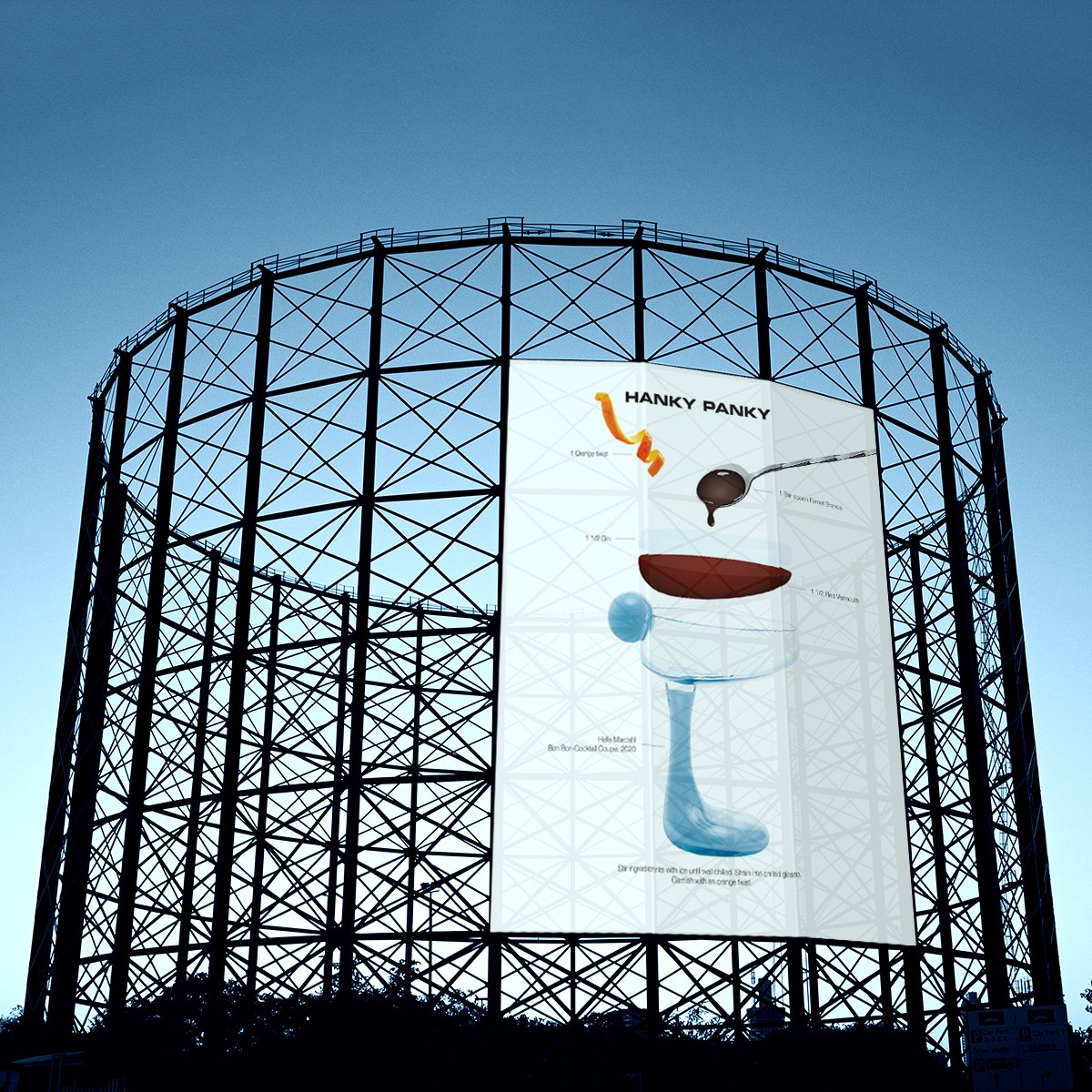
By Jove It's the Real Hanky Panky!

HankyPankyGasIOK.jpg HankyPankyGinClubIOK.jpg HankyPankyOldSignOK.jpg HankyPankyBarIOK.jpg HankyPankyTheGinIOK.jpg HankyPankyWallOK.jpg

Ada Coleman, or just ”Coley” as she was known by her friends and customers, was a true bartender legend. As head bartender at the American Bar at the Savoy in London between 1903 and 1926 she created and served cocktails to the likes of Mark Twain and the Prince of Wales.

A comedic actor called Charles Hawtrey was a regular at the bar during the 1920s and he frequently asked Mrs Coleman for new cocktails with a bit of punch in them. After some experimentation she came up with a cocktail she wanted him to try. Draining the glass Mr Hawtrey exclaimed “By Jove! This is the real hanky-panky!” and the name stuck. At the time hanky-panky meant ‘magic’ or ‘witchcraft’.

The Hanky Panky is quite similar to its predecessor the Martinez but instead of Maraschino and bitters Coleman used Fernet Branca.

In 1926 the Savoy decided to install an American as head bartender at the American Barand picked Harry Craddock, a legend in the making, who was already working the bar, while Ada Coleman retired to the hotel’s flower shop. Craddock was actually an englishman who emigrated to New York in 1897 but returned to England with an American accent as soon as Prohibition hit the US.

Mr Craddock went on to make the influential Savoy Cocktail Book in 1930 and creating classics such as the White Lady and the Corpse Reviver No 2.

The cocktail coupe is called Bon Bon and was designed by Helle Mardahl in 2020.

Hanky Panky

1 part Sweet Vermouth
1 part Gin
1 barspoon Fernet Branca
1 Orange twist

Stir the ingredients in a mixing glass filled with ice. Strain into chilled glass and garnish with an orange twist.

Enjoy the magic of Ada Coleman.

tags: poster, wallart, fineartprint, glassdesign, cocktails, classiccocktails, gin, sweetvermouth, fernetbranca
categories: Illustration
Thursday 09.29.22
Posted by Erik Coucher
 

To the Moon And Back

MoonwalkQuarantineSOK.jpg MoonwalkLiftOffIOK.jpg MoonwalkWallOK.jpg MookwalkTarmacIOK.jpg MoonwalkMoonwalkIOK.jpg

On July 20 1969 Neil Armstrong was the first human setting foot on the moon after safely landing the Apollo 11 Eagle lunar module in the Sea of Tranquility. It was an incredible feat of engineering seen by 600 million people glued to their tv screens across the planet, effectively making the US take the lead in the space race. Four days, six hours and 45 minutes after leaving earth the crew of three, Armstrong, Buzz Aldrin and Michael Collins returned safely to Earth. After a 21 day quarantine (nobody knew what disease or bacteria could be caught during space travel) the crew went on a 45 day, 24 country celebratory Apollo 11 “Giantstep Presidential Goodwill World Tour”.

Before traveling across the globe they celebrated with cocktails and the first cocktail they had after returning from space was a Moonwalk. The cocktail was the invention of Joe Gilmore, head bartender at the Savoy’s American Bar in London. Even though the world tour took the astronauts to London mr Gilmore never got a chance to serve them his concoction at his bar. Instead he made the crew a batch of the cocktail and sent it to the US along with Champagne and glasses and this was the very first cocktail they had after quarantine.

Commemorative cocktails seem to have been something of a speciality of Joe Gilmore’s. Apart from the Moonwalk he made several specialty cocktails for Winston Churchill’sbirthday parties as well as many drinks honoring royal weddings and births. He also made yet another space themed cocktail in celebration of the first international space mission in 1975, a drink called Link Up.

The cocktail glass, another product made in honor of the Apollo 11 expedition, was made by Libbey in 1969 and is called Moonshot.

Moonwalk

1 part Grand Marnier
1 part Grapefruit juice
1 dash Rose water
2 parts Champagne

Shake all but Champagne with ice. Strain into a Moonshot glass and top with Champagne.

Enjoy while looking at the amazing photos on nasa.gov or watching your favorite sci-fi movie.

tags: poster, wallart, fineartprint, cocktails, champagne, nasa, apollo11, moonlanding
categories: Illustration
Friday 09.23.22
Posted by Erik Coucher
 

¡Viva México!

BanderitaSanbornIOK.jpg BanderitaSombreroIOK.jpg BanderitaLatinAmericanIOK.jpg BanderitaCactusIOK.jpg BanderitaDoorIOK.jpg BanderitaStreetIOK.jpg

Today, September 16, is Mexican Independence Day in memory of their independence from Spain in 1810. What better way to celebrate than to have a Banderita, “Little flag”, a drink made up of three glasses, the first with freshly squeezed lime juice, the second with Tequila and the third with Sangrita, together making up the colors of the Mexican flag.

The Sangrita, playing the role of chaser (or rather of a sipper) in the Banderita, should rather be considered the star and is in itself said to make or break a Mexican restaurant. The Sangrita, meaning “Little blood” in Spanish, is a very traditional drink originating in Jalisco, the Mexican state where tequila is made. It is said to have been made from the leftover juices at the bottom of a bowl of pico de gallo, a fruit salad popular in Guadalajara. The juice was poured into clay cups and was drunk together with tequila after dinner as a well needed digestif.

The Mexican versions of the Sangrita is generally more citrus focused with grapefruit, orange and lime whilst American recipes tend to lean more towards tomato juice, rather like a citrusy Virgin Mary, and just like a Bloody Mary, every bar has its own take. Whatever the base, the Sangrita is there to perfectly balance the earthy notes of the tequila, enhancing rather than masking its flavor.

The glasses are called Fasetti and were designed by Finnish designer Kaj Franck in 1964.

Sangrita

1 part Tomato juice
1 part Lime juice
1 part Pomegranate juice
1/2 part Orange juice
1/3 part Grenadine
1 dash Hot pepper sauce
2 dashes Worchestershire sauce
black pepper
salt

Shake all ingredients with ice and strain into glass.

¡Viva México!

tags: tequila, mexico, cocktail, poster, wallart, fineartprint
categories: Illustration
Friday 09.16.22
Posted by Erik Coucher
 

God Save the Queen

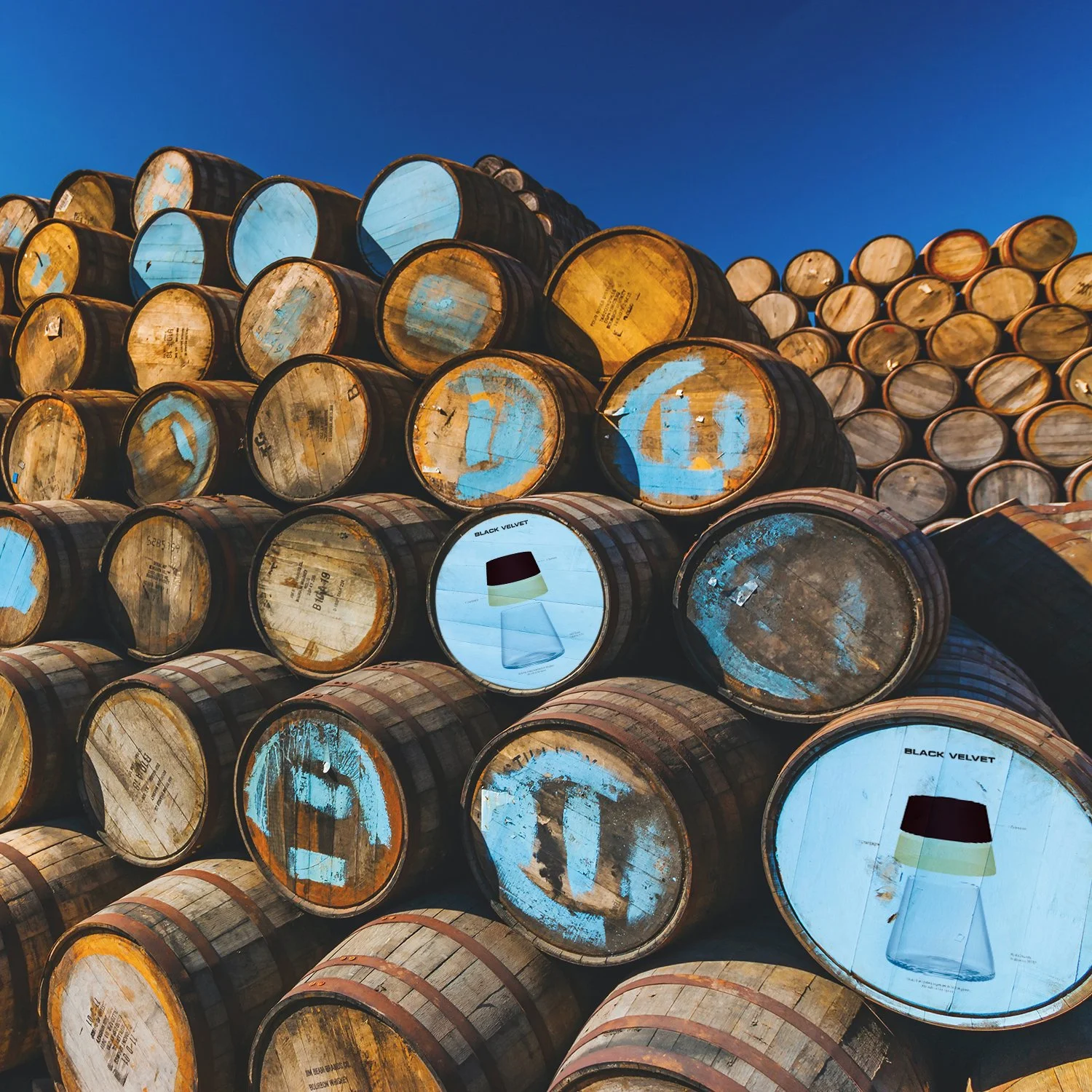
BlackVelvetStampIOK.jpg BlackVelvetDrumIOK.jpg BlackVelvetBusIOK.jpg BlackVelvetGuardIOK.jpg BlackVelvetTrainOK.jpg BlackVelvetBarrelsIOK.jpg

Considering the sad passing of Her Majesty Queen Elizabeth II, who ruled for longer than any other Monarch in British history, the Black Velvet seemed a proper tribute honoring the Queen’s memory.

The Black Velvet was first served in 1861 as a tribute to another British Royal, Prince Albert, the husband of Queen Victoria, after his death of typhoid fever. It was created after a steward at Brook’s Club in London ordered that even Champagne should be in mourning, dressed in all black.

Prince Albert was famously supportive of the working class whom he described as “that class of our community who have most of the toil and fewest of the enjoyments of this world”. At the time of Prince Albert’s passing, porter (getting its name from the porters working on the streets of London) and stout were the preferred drinks of the working class so combining stout and the upper class Champagne was like making the British come together in mourning. 

The Fujiyama glass was designed by Keita Suzuki in 2012 and made at the Japanese glassworks Sugahara. The design is inspired by Mount Fuji and when used for beer the head will form a snowy top on the mountain.

Black Velvet

1 part Guinness
1 part Champagne

Slowly pour the Guinness and then the Champagne in a chilled glass. Stir gently.

tags: poster, wallart, fineartprint, champagne, blackvelvet
categories: Illustration
Friday 09.09.22
Posted by Erik Coucher
 

A Car Exec and the Last Word of a Vaudeville Performer

LastWordTrainOK.jpg LastWordWallOK.jpg LastWordTimeIOK.jpg LastWordDetroitWindowOK.jpg LastWordDetroitOK.jpg LastWordAirplaneIOK.jpg

In the early 1900s the president of the Packard Motor Car Company, Henry Bourne Joy, thought that his likes in the booming automobile industry ought to have a proper club instead of meeting in regular bars. He took the already existing Detroit Athletic Club, founded in 1887, and together with 108 prominent Detroiters he hired an accomplished architect to create a stately building in the center of Detroit’s entertainment district. Architect Albert Kahn had recently traveled to Italy and was inspired in his design by Palazzo Borghese and Palazzo Farnese in Rome when he set out to build the six story Clubhouse, which was completed in 1915.

The club featured athletic facilities, pools, restaurants, ball rooms, guest rooms and, of course, a bar and this is where the Last Word cocktail saw the light of day around 1915. The creator is likely to be vaudeville performer Frank Fogarty, also known as the Dublin Ministrel for his Irish anecdotes. Fogarty was performing at Detroit’s Temple Theater at the time, and the name of the cocktail might be an allusion to the monologue with which he closed his act.

The recipe for the Last Word didn’t appear in print until Ted Saucier’s 1951 Bottoms Upwhere he calls Fogarty “a very fine monologue artist”. After Bottoms Up the cocktail fell out of favor until bartender Murray Stenson at the Zig Zag Café in Seattle found it in the Saucier book in 2004. Stenson made it a hit starting in Seattle and Portland and finally finding its way around the world.

The cocktail glass was designed in 1964 by Polish glass designer Wszewłod Sarnecki.

Last Word

1 part Gin
1 part Green Chartreuse
1 part Maraschino
1 part freshly squeezed lime juice
1 Maraschino cherry garnish

Shake all ingredients with plenty of ice. Strain into chilled cocktail glass and garnish with a maraschino cherry.

Enjoy while looking through Ted Saucier’s Bottoms Up looking for new cocktails that deserve a second chance.

tags: classiccocktails, glassdesign, gin, maraschino, detroit
categories: Illustration
Friday 09.02.22
Posted by Erik Coucher
 

A Taste of the Caribbean

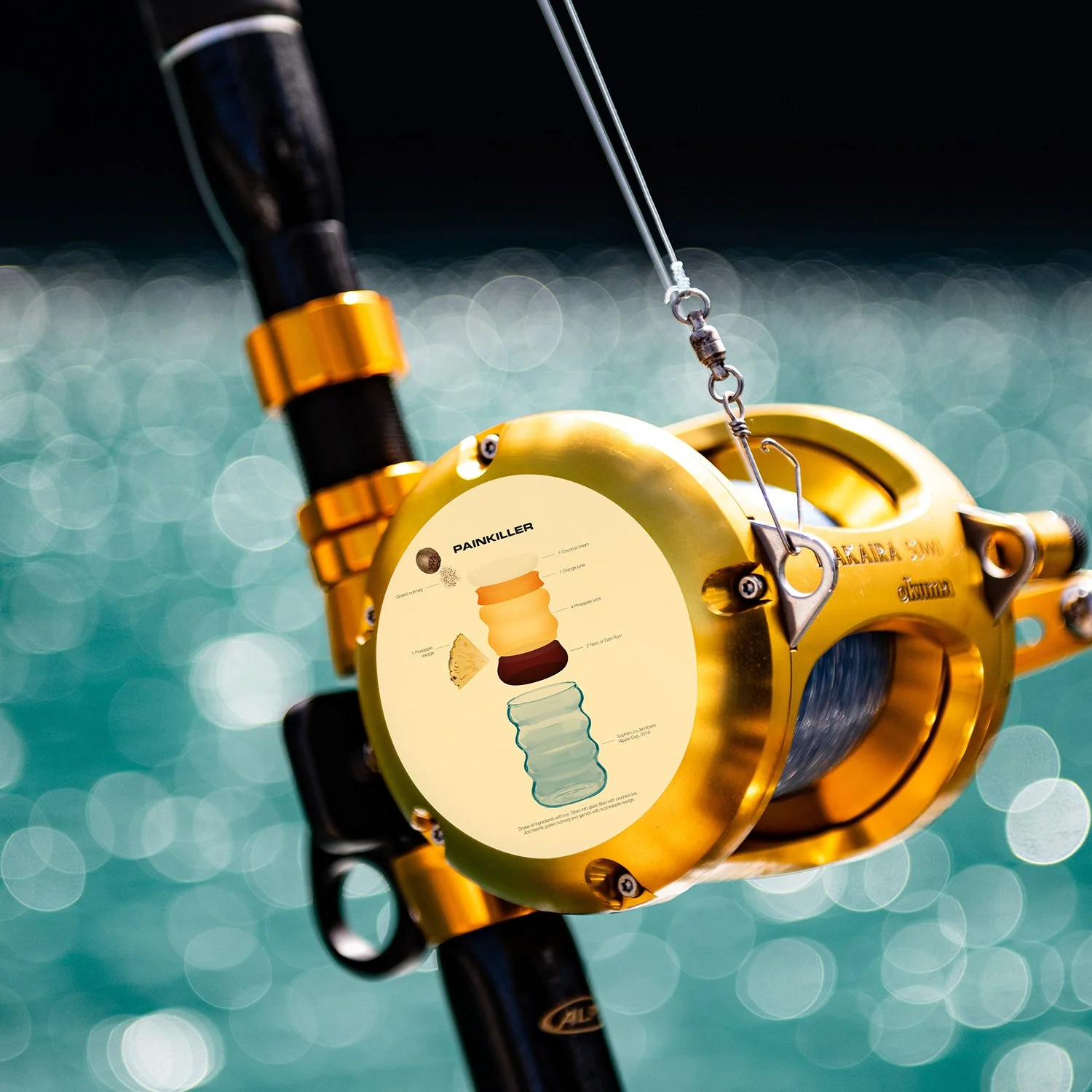
PainkillerSunbedIOK.jpg PainkillerCruiseOK.jpg PainkillerIguanaIOK.jpg PainkillerViewOK.jpg PainkillerFishingIOK.jpg PainkillerWallOK.jpg

The Painkiller is essentially a riff on the Piña Colada, created in Puerto Rico in 1954. The only difference being the addition of orange juice and nutmeg. It was first made some twenty years later by Daphne Henderson, owner of a small bar called the Soggy Dollar Bar at White Bay on the island of Jost Van Dyke in the British Virgin Islands. The bar got its name due to the fact that White Bay lacked a jetty and the patrons usually swam to shore from their boats and ending up with a pocket full of wet bills.

One of the frequent guests enjoying the Painkiller was Charles Tobias, founder of Pusser’s Rum. Even after becoming friends with Daphne Henderson he tried to get her to reveal her secret concoction but she persistently refused. After two years he finally snuck a drink from the bar, brought it home and started experimenting on his own to recreate the drink. The following Sunday he was back and challenged Ms Henderson to a $100 bet and taste test among the ten customers at the bar to settle which version was better. A bet he won.

Originally the drink was made with Cruzan Rum, a product of the US Virgin Islands(Pusser’s Rum Ltd. didn’t start until 1979 and wasn’t around when the Painkiller was created), but in 1989 Charles Tobias managed to file a US trademark on the name and recipe for the Painkiller making it illegal to call it a Painkiller if it’s not made with Tobias’sown Pusser’s Rum. In 2011 Pusser’s Rum even took a New York Tiki bar named Painkillerto court both for using the trademarked name and for serving Painkillers made with rum other than Pusser’s. This in turn led to bartenders across the US to boycott Pusser’s.

The glass, called Ripple Cup, was designed in 2019 by French-American designer Sophie Lou Jacobsen.

Painkiller
2 parts Navy or Dark Rum
4 parts Pineapple juice
1 part Orange juice
1 part Coconut cream
1 Pineapple wedge
Freshly grated nutmeg

Shake with ice and strain into ice filled glass. Garnish with a pineapple wedge and freshly grated nutmeg.

Enjoy it like you are in the Caribbean.

tags: poster, wallart, fineartprint, glassdesign, cocktails, rum, caribbean
categories: Illustration
Friday 08.26.22
Posted by Erik Coucher
 

Another New Orleans Original

RamosFizzWindowIOK.jpg RamosFizzGroceryIOK.jpg RamosFizzBourbonIOK.jpg RamosFizzDoorIOK.jpg RamosFizzTramIOK.jpg RamosFizzWallIOK.jpg

This iconic New Orleans drink was created by a very unlikely bar owner. Mr. Henry C. Ramos was born in Indiana but started his career in a beer saloon in Baton Rouge. After some years he decided to buy a bar in New Orleans together with his brother and in 1887 they bought the Imperial Cabinet on Gravier Street. This was where Henry, or Carl to his friends, created the Ramos Fizz in 1888, originally the New Orleans Fizz.

The reason Mr. Ramos was such an unlikely bar owner was that he was a teetotaler and absolutely despised drunkenness. Everyday he walked around his bar talking to the customers to check their level of tipsiness and refusing to serve any more cocktails to intoxicated guests. To make absolutely sure that the Imperial Cabinet stayed a respectable establishment he only accepted the most well-behaved customers. For the same reason he closed the bar every evening at eight o’clock and kept the bar open for a mere two hours on Sundays afternoons and this only after he was talked into it.

Mr. Ramos also had strict rules for how his Ramos Fizz was made stating that it should be shaken for no less than 12 minutes. Since the drink was an instant success he had to keep 20 “shaker boys” making the Ramos Fizz on staff at any given time and even more during Mardi Gras. On October 27, 1919 the last Ramos Fizz was served and the doors of the Imperial Cabinet were closed due to Prohibition, something Mr. Ramos, as a teetotaler fully supported. The recipe remained a secret until he finally revealed it to a reporter from New Orleans Item-Tribune just days before his passing in 1928.

Ramos Fizz

2 parts Gin
1/2 part Lemon juice
1/2 part Lime juice
3/4 part Sugar syrup
1 part Crem
1 Egg white
2 dashes Orange flower water
1-2 parts Club soda

Shake all ingredients except soda without ice (dry shake), preferably 12 minutes. Add ice and shake again. Pour slowly into chilled glass. Add club soda to the shaker to get the remaining froth and pour slowly into glass.

tags: poster, wallart, fineartprint, gin, glassdesign, fizz, neworleans
categories: Illustration
Saturday 08.13.22
Posted by Erik Coucher
 

Something Swedish For Midsummer

GronaHissenOldTownIOK.jpg GronaHissenWallOK.jpg GronaHissenScraperIOK.jpg GronaHissenElevatorIOK.jpg GronaHissenMercedesIOK.jpg GronaHissenPrinsenIOK.jpg GronaHissenIOK.jpg GrönaHissenOK.jpg

One of the biggest and most important celebrations in Sweden is Midsummer when Swedes leave the city and gather around the Midsummer pole, eat herring and down a copious amount of nubbe (schnapps). What then could be better than presenting one of the very few truly Swedish cocktails, Gröna Hissen (The Green Elevator).

The history of this very Swedish drink actually started, in a very roundabout way, with an American play called “Fair and Warmer” written in 1915 by American playwright Avery Hopwood. In 1921 the play found its way to Stockholm and the title was changed to “Gröna Hissen” (“The Green Elevator”). The lead in this popular production was played by Swedish actor Gösta Ekman and since cocktails was a big part of the play it didn’t take long until a cocktail was made in honor of the play and the beloved Gösta Ekman.

In 1944 the play was adapted to the cinema where the leads were played by Sickan Carlsson and Max Hansen giving the drink an even further boost.

The drink itself is a bit gimmicky with three raisins being added just to travel up and down thanks to the carbonation in the Champis or Pommac, two brands of a very Swedish soda originating in 1910 and 1919 respectively. This type of soda was first marketed as Champagnedricka (Champagne Soda) and was introduced to be a non alcoholic but yet sophisticated substitute for Champagne even though it was a whole of a lot sweeter. The name Pommac was taken from pomme, French for apple being a main ingredient, and Cognac, supposedly added to create a fuller bodied drink.

The Pommac brand was early to adopt marketing and PR strategies. At the Jubilee Exhibition in Gothenburg 1923 the just four year old company arranged an 11 meter wide Pommac tower serving the soda to half a million visitors. During the 1940s Pommac had famous Swedish artists make Pommac ads, much the same way as Absolut Vodka did decades later. Among these artists were Isaak Grünewald, Stellan Mörner and Sven X:et Erixon.

The glass called Vogue was designed by the Swedish designer Simon Gate in 1931.

tags: cocktails, classiccocktails, sweden, midsummer, fineartprint, poster, wallart
categories: Illustration
Saturday 06.25.22
Posted by Erik Coucher
 

What To Drink During Milano Design Week Day 7

Being the last day of Milano Design Week why not end with a classic, the Bellini. Even though it wasn’t created in Milano it is as Italian as Leonardo da Vinci and it makes for a great celebration of a fantastic week of design.

The Bellini was created in 1948 by Giuseppe Cipriani at the world famous Harry’s Bar in Venice. The drink was named Bellini because its pink color reminded Cipriani of the toga of a saint in a painting by 15th-century Venetian artist Giovanni Bellini. Harry’s Bar first opened in Venice in 1931 and was a favorite hangout for Ernest Hemingway, Truman Capote, and Orson Welles. In 2001 Harry’s Bar was declared a national landmark by the Italian Ministry for Cultural Affairs.

The Jellies Family Flute was designed by Patricia Urquiola in 2014 for the Italian company Kartell.

tags: milano, milanodesignweek, classiccocktails, cocktails, bellini
categories: Illustration
Sunday 06.12.22
Posted by Erik Coucher
 

What To Drink During Milano Design Week Day 6

The Negroni Sbagliato (meaning mistaken or erroneous Negroni) was created in 1972 when Mirko Stocchetto at the historic Bar Basso in Milan added sparkling wine instead of the gin by mistake to a Negroni. A little lighter than a regular Negroni and close to the Spritz Veneziano the Negroni Sbagliato makes for a perfekt summer cocktail.

The glass is called X-Series and is a design by Finnish designer Tamara Aladin and was created in 1961.

So, if you happen to be in Milano, why not head straight to Bar Basso on Via Plinio 39 and have a Sbagliato where it was created, celebrating a 50 years old great mistake.

tags: milano, milanodesignweek, cocktails, classiccocktails, aperitivo, negronisbagliato, campari
categories: Illustration
Saturday 06.11.22
Posted by Erik Coucher
 

What To Drink During Milano Design Week Day 5

The Spritz Veneziano, also known as Aperol Spritz, originated around the 19th century in Venice. The Hapsburg soldiers that occupied the area thought the Venetian wines were too strong in alcohol so they started adding a spritz of water to the wine. At the turn of the nineteenth century, soda water was added instead of water and during the 1920s and 1930s a bitter was included, making it a real cocktail. Not until the 1990s Prosecco was finally added to the Spritz Veneziano.

The glass, called Smoke, was designed by Joe Colombo in 1964 and was made to make it easier to hold your cigarette and your glass in the same hand.

tags: milano, milanodesignweek, aperitivo, spritz, aperol
categories: Illustration
Friday 06.10.22
Posted by Erik Coucher
 

What To Drink During Milano Design Week Day 4

The Americano is a precursor of the Negroni. (The Negroni was created for Count Camillo Negroni who wanted something more potent than the classic Americano). Actually, the very first drink that James Bond ever ordered in one of Ian Fleming’s books about the British Secret Agent wasn't a Vesper, it was a Negroni. This was in Ian Fleming’s Casino Royale from 1953.

The glass called Cibi was designed by Italian architect and designer Cini Boeri in 1973 and was considered so futuristic it was featured in Ridley Scott’s Blade Runner from 1982.

tags: milano, milanodesignweek, aperitivo, campari, americano
categories: Illustration
Thursday 06.09.22
Posted by Erik Coucher
 

What To Drink During Milano Design Week Day 3

The Angelo Azzurro was created in 1980 by bartender Giovanni “Mammina” Pepè for the opening of one Rome’s most popular LGBTQ + clubs, L’Angelo Azzurro in Trastevere with the cocktail mimicking the color of the walls in the club. The cocktail made with gin, triple sec and blue Curaçao is basically a modernized version of the Blue Logoon from the fifties and sixties. The Angelo Azzurro was made a big hit in bars all over the world when Sonny Crockett (Don Johnson) ordered it in Miami Vice. It is hard to believe that Giovanni “Mammina” Pepè could ever imagine how big of a success the Angelo Azzurro would become.

The glass called Memphis was designed by Richard Holloway in 1982.

tags: milano, milanodesignweek, aperitivo, angeloazzurro
categories: Illustration
Wednesday 06.08.22
Posted by Erik Coucher
 

What To Drink During Milano Design Week Day 2

Count Camillo Negroni was the adventurous type. In 1892 he arrived from Italy to Ellis Island to try his fortunes in the US. There he supposedly worked as a banker, a cowboy and as a riverboat gambler before returning back to Florence.

In 1919, he stepped into his favorite bar, the Caffè Casoni in Florence, ready to try something new. His friend and bartender Fosco Scarselli substituted gin for soda from the Americano and thus created the perfect aperitivo cocktail, the Negroni.

Even though Negroni returned to Italy he was so influenced by his time in the US that when an American newsman bumped in to him on a trip to Italy in 1928, he walked around dressed in his cowboy attire.

The tumbler was designed by Massimo Vignelli in 1957 and produced by Venini on the island of Murano, just outside Venice, Italy.

tags: milano, milanodesignweek, negroni, massimovignelli, aperitivo, campari, gin
categories: Illustration
Tuesday 06.07.22
Posted by Erik Coucher
 

What To Drink During Milano Design Week Day 1

Today Milano Design Week starts and if you are new to the city and want to look like it isn’t your your first rodeo, here are some tips on what to drink during your aperitivo. One distinctly Italian aperitif every day from Monday to Sunday starting with Milano – Torino.

As with a lot of older cocktails the origin is unknown and there are several different origin stories. The same goes for Milano-Torino. One story is that it was first served at Gaspare Campari’s Caffè Camparino in Milan in the 1860’s. Another that it was created in 1932 to celebrate the inauguration of the A4 Highway that connects Milano and Torino. Whatever the origin it is made with equal parts Campari from Milano and Punt e Mes from Torino.

The glass is one in a series of three glasses called Calci Milanesi and was designed by Agostina Bottoni in 2018 as a tribute to Milanese architecture.

tags: milanodesignweek, aperitivo, campari, puntemes, milano
categories: Illustration
Monday 06.06.22
Posted by Erik Coucher
 

A Super Sneaky Tiki

SneakyTikiWallOK.jpg SneakyTikiCastroOK.jpg SneakyTikiChinatownOK.jpg SneakyTikiHouseOK.jpg SneakyTikiOK.jpg SneakyTikiGoldenGateOK.jpg SneakyTikiCasinoOK.jpg SneakyTikiCardsOK.jpg

This is a tiki drink that wasn’t created by one of the tiki bar giants, Trader Vic or Don the Beachcomber. It was created either at the Wheel Bar at Harvey’s Casino Resort in Lake Tahoe or at Tiki Bob’s in San Francisco.

Harvey’s first opened right after WWII by gambling pioneer Harvey Gross. It started small with just six slot machines and eventually grew to a casino empire. In fact, it was the very first casino in Lake Tahoe, right at the border between Nevada and California.

Even though the Sneaky Tiki is fairly well known Harvey’s is probably more famous for a very well documented extortion attempt in 1980 when a disgruntled casino guest made a highly sophisticated boobytrapped bomb that he placed in the casino. The extortionist wanted to get $3 million from mr Gross after having lost $750,000 gambling. Harvey Gross refused to pay a dime and while the bomb squad tried to disarm the bomb, the 1,000 pounds of dynamite blew a five story hole in the building costing $18 million in repairs but luckily no lives.

Another possible creator of the Sneaky Tiki was “Sneaky” Bob Bryant. He worked in San Francisco as a bar manager for Trader Vic, who taught him the tricks of the trade. After a falling out with Victor Bergeron himself “Sneaky” Bob left and in 1955 he started his own tiki bar just down the street. A bar he named Tiki Bob’s. Decorated with Polynesian and Asian artifacts and having the guests welcomed by a 50s style tiki column right outside the entrance mr Bryant made a bar rivaling his former employer. The bar’s signature drink was called the Super Sneaky Tiki. “Sneaky” Bob had the foresight to introduce the tiki mug to his bar, a new concept at the time. The design for Tiki Bob’s logo and Tiki mug was made by Alec Yuill-Thornton, an illustrator who had previously worked with Trader Vic illustrating his book Kitchen Kibitzer. Being one of the first Tiki mugs it is highly sought after by collectors.

The only difference between the Sneaky Tiki and the Super Sneaky Tiki is that the latter is made with orange juice instead of pineapple juice and it’s made with only light rum.

Sneaky Tiki
1 part Dark Jamaican Rum
1 part Light Puerto Rican Rum
1/4 part Curaçao
1 1/2 part Pineapple juice
1 part Lemon juice
1/4 part Grenadine

Mix ingredients with ice in blender until smooth. Garnish with an orange wheel and a Maraschino cherry.

tags: jamaicanrum, puertoricanrum, tiki, tikidrinks, tikibob
categories: Illustration
Friday 05.20.22
Posted by Erik Coucher
 
Newer / Older

Powered by Squarespace.